Aram Bartholl

english / deutsch

Works Blog Calendar Public. & Press Resume & Exhibitions Contact
Topic Member of Calendar
"In which form does the network data world manifest itself in our everyday life? What returns from cyberspace into physical space? How do digital innovations influence our everyday actions?"

F.A.T. Lab

My

blog
flickr
vimeo
twitter
dopplr

15.-18.4.10 Jury "Digital Communities" Ars Electronica
8.-11.3.10 "Point and click" workshop at KHM, Cologne, Germany
11.-21.2.10 "0,16" at Directorslounge @Meinblau, Berlin, Germany
2.-7.2.10 F.A.T. lab at Transmediale "Futurity now!", Berlin, Germany
9.1.10 Talk at 'Jean Luc' think tank at HAU2, Berlin, Germany
17.12.09-19.1.10 "First Person Shooter" at FACT, Liverpool, UK
22.10.-8.5.2010 "First Person Shooter", "1H" at BYU MOA, USA
...
past events
2009
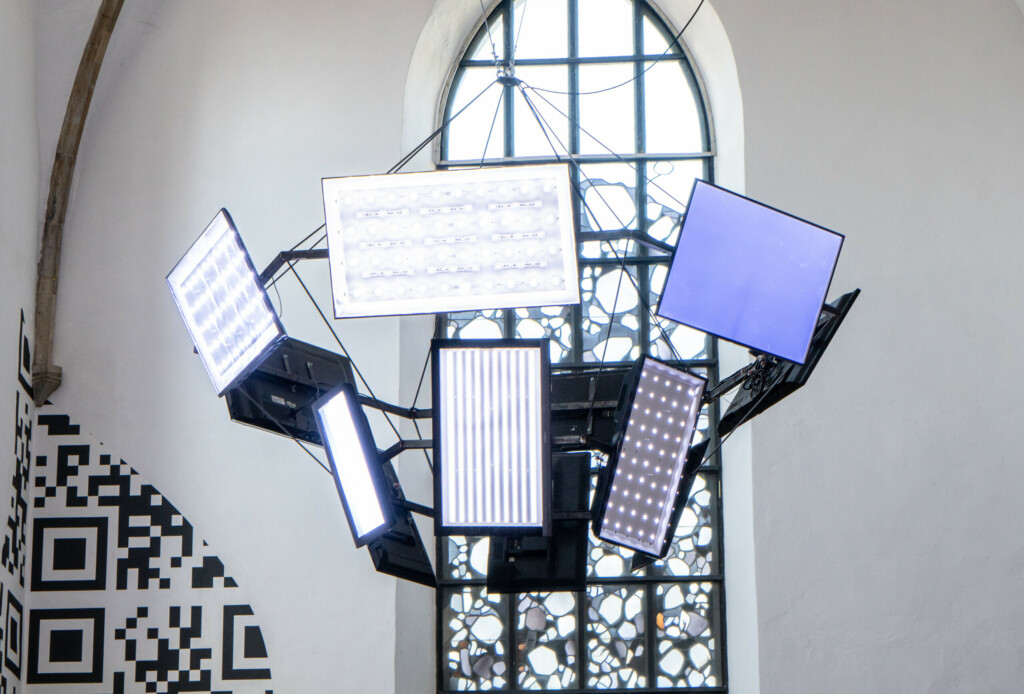
0,16
Dimensions: 35 x 100 x 280 cm
Materials:
chipboard 10mm, corrugated board 2mm , transparent paper, ETC Source Four zoom 25-50° 750W, tripod, dimmer


more...
Google Portrait Series
A Google Portrait is a drawing which contains the Google URL search string of the portrayed person in encoded form. Any camera smart phone is capable to decode the matrix-code with the help of barcode reader like software. The result points the mobile phone browser to a a search on the portrayed person's name at Google.

more...
Tweet Bubble Series
The Tweet Bubble Series consists of four wearable speech bubble prototypes developed during a three month residency at V2_, Institute for the Unstable Media. All four prototypes are based on the idea that a Twitter user shows his/her latest Twitter post in the form of a wearable speech bubble on the clothing in public. Twitter’ is a Web2.0 platform that fills the gap between blogging, instant messaging, and SMS. All messages posted on Twitter are public by default and stored as single HTML pages. ...

more...
"Are you human?"
CAPTCHA is the acronym for “Completely Automated Public Turing test to tell Computers and Humans Apart" and was developed in 2000 by information scientists at the Carnegie Mellon University, USA. Web-based services such as Yahoo require users to recognize and type a randomly generated series of letters or numbers which appear on the screen as a CAPTCHA image...

more...
On
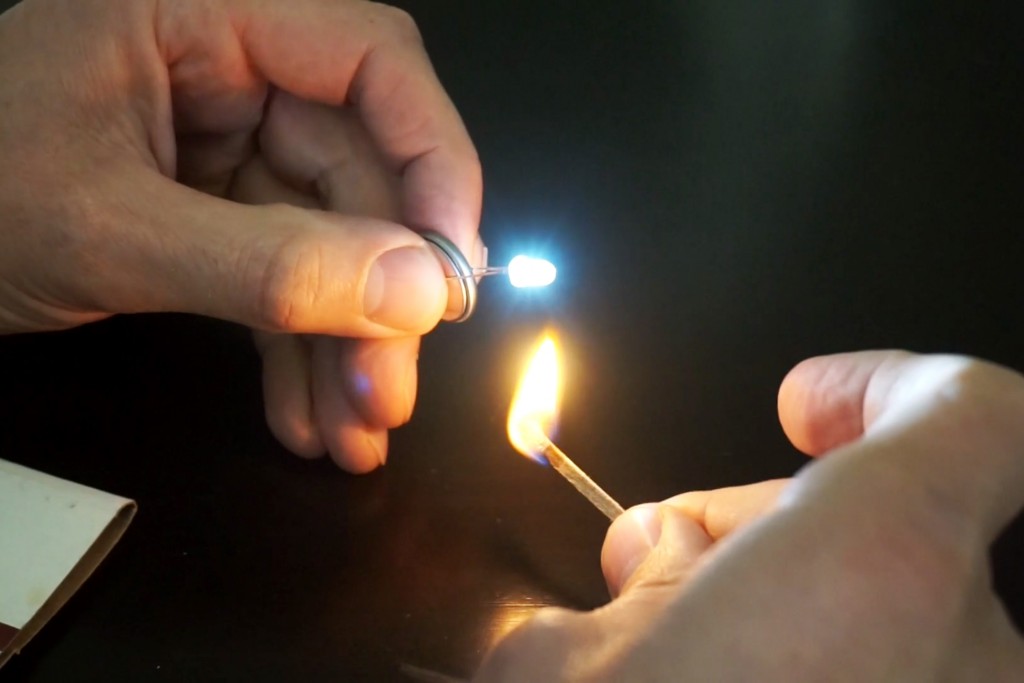
A resistance wire, similar to one in a classic light bulb, is wound into a spiral and slipped over the wick of the candle. Both ends are soldered to copper wire which leads down to the switch which is fixed by a cable tie to the candle. The switch controls a 12 V power transformer. The resistance wire glows up very briefly before the heat breaks the metal. The candle is lit.

more...
2008
Sociial


Sociial is a 17-minute performance presented by four protagonists and an announcer in a stage-like situation. The four "dancers" play tennis on a Nintendo Wii game console while every 10 seconds the announcer reads out descriptions a selection of 100 Web 2.0 services. [...]
Removed from the virtual events, however, the players also seem absent, due to their high degree of concentration and physical action. In involuntary comedy, the movements contrast the difference between virtual area and physical action.

more...
Jump'n Run Shanghai and QQ PaperChat


"Jump'n Run Shanghai" is a physical reenactment of the video game Super Mario. "QQ PaperChat" is a paper based version of the popular chinese chat service QQ. During four worshop days two public interventions were developed by a group of 10 chinese media and design students. After some intense days of discussing, translating and testing the interventions where performed in public space....

more...

China Channel


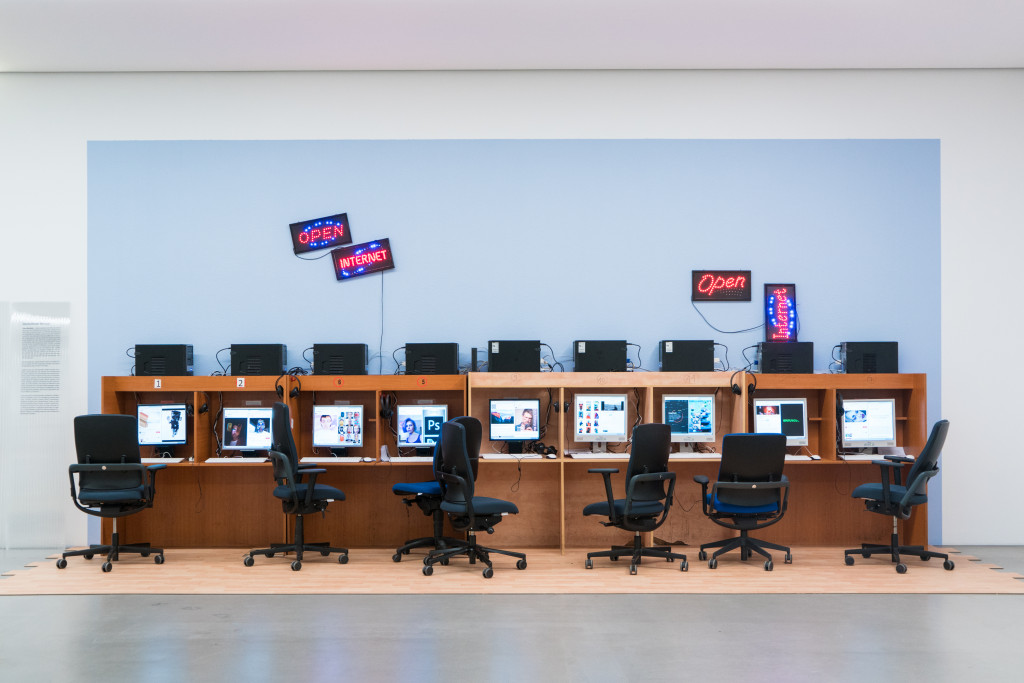
The Firefox add-on China Channel offers internet user outside China to surf the web as if they were in China. For the gallery installation two computers are connected to a single keyboard and mouse allowing visitors to control both identical machines at the same time while using just a single input device. The only difference between the two internet terminals is their network connection; one machine is connected to the less restricted internet in Hong Kong, while the other is connected to the internet through a connection point in the mainland of China. China Channel was developed in colaboration with Evan Roth and Tobias Leingruber

More info and the addon can be found on the China Channel project page.
Friends


The project Friends is a workshop which translates the so-called social web - online services such as Facebook, Myspace, etc. - into a paper-based form in physical space. All workshop participants contribute a profile page to the big Friends Book and make their own personal friends booklet in which to collect as many friends as possible. With their own hand-made profile photo stamp and a large amount of prefabricated web 2.0 service stamps, users trade among each other information about their favorite online services and web activities.

more...
Follow me!


The project "Follow me!" is a social intervention and group performance for conferences and events connected with the Web. Just as with micro-blogging services such as Twitter, Jaiku or Pownce, the participants of the project interact with each other using the symbols and rules of social web services in real space. Each participant receives a pin-on button and several stickers of his/her Twitter (or other) profile photo or logo. The button is worn on the shirt, T-shirt, pullover or jacket and enables other conference participants to recognize "Twitter friends".

more...
1H
"1H" is a workshop and performance piece for a Public Space. In a two day workshop a group of participants are building weapon paper models extracted from the online computer game "World of Warcraft". Oversized axes, swords and other archaic weapons made from paper and cardboard find their way into the physical world.

more...
2007
"Are you social?"


The triumphal march of Web2.0 with services like Flickr, YouTube and MySpace in the last two years has led to a new internet boom. [...] The T-shirt "Are you social?“ shows a list of the best-known social web services (as of 08/2007) with their icons and a check box. The owner of the T-shirt is expected to mark the services he uses with a pen and to wear it in public. What happens when users start wearing their network identities openly in public? What does identity mean in the age of Web2.0?

more...
Sandbox Berlin


The Sandbox is a place available to all inhabitants of Second Life as a test platform and experimental field. Each user can produce and programme new objects with their own individual textures. The Sandbox is a clash of cultures - of digital and analogue clichés - a place of interaction in every form.
Sandbox Berlin translates this field of experimentation into public space in Real Life. In a three-day workshop, production of custom objects in a spontaneous and collaborative process will be tested in Real Life.


more...
Second City


The so called "Second City" part of the Ars Electronica festival 2007 was situated in a deserted shopping street between other festifal places life Ok-Center, the conferecen Forum and Pfarrplatz. The festival management rented all empty shops of Marienstrasse and turned 3/4 of the street into an exhibition space. Besides the over all topic "Good by Privacy" Second Life and metaverses was a sub topic of Ars Electronica 2007.

more...
Chat


The Chat project is a mobile performance installation that can be played by two people at a time. Just like in World of Warcraft or Second Life, the two participants communicate with each other in the form of brief text messages input via keyboard. Immediately after they’ve been entered, the written communiqués appear in comic-strip-like dialogue balloons projected above the speaker’s head.

more...
Speech Bubble
Tree


The project „Tree“ is an object imported from the 3D online world “Second Life”. The unfinished “virtual” tree becomes part of everyday life in public space.
Almost every computer game or 3D world simulates objects of everyday life in a simplified way. By following the rules of computer programming vector objects and image textures form the bases for “realistic” real time rendered images. The most simple way to construct a tree in a virtual environment is to join two vertical surfaces covered with the same image texture of a picture of a tree.

more...
256²


Speech Bubble is a performance which thematizes the very common text based communication form chat in online computer games like World of Warcarft or Second Life.
To have a "conversation" via the keyboard has become a communication standard during the development of the internet.

more...

"256² " is an intervention in Public Space. In this temporary piece the outline of the virtual NewBerlin in Second Life was marked by Aram Bartholl in physical space at Alexanderplatz Berlin, 15.03.2007.
Jan Northoff and Tobias Neisecke from YOUseeMEin3D.com have the vision to rebuilt Berlin entirely in Second Life. In spring 2007 they started to build the center of NewBerlin in Second Life. The TV tower at Alexanderplatz is right in the middle of the first Sim.

mehr...

Missing Image
The long sleeve shirt Missing Image is a playful transformation of a texture graphic error from the virtual environment Second Live to every day life. Every object in a virtual space consists of a three dimensional vector information and a two dimensional surface information, which is in most cases a texture image. Also the avatars which are the representations of the players in
Second Life consist of a 3D model and a custom made surface.

more...
2006
Plazemark


Plazemarks are real life representations of digital places generated by users of the Location Based Web2.0 platform Plazes.com.
Plazes.com is a service wich tracks the location of users in the real world. Just by everyday technologies like routers, wifi or GSM without any GPS services user can locate themself in the city. With a small piece of software they can log on to hundreds of thousands of plazes created by other users. Each plaze shows a history: who has been there, what did they say? Pictures can be uploaded or connected location sensitive via Flickr to each plaze.

more...
Map


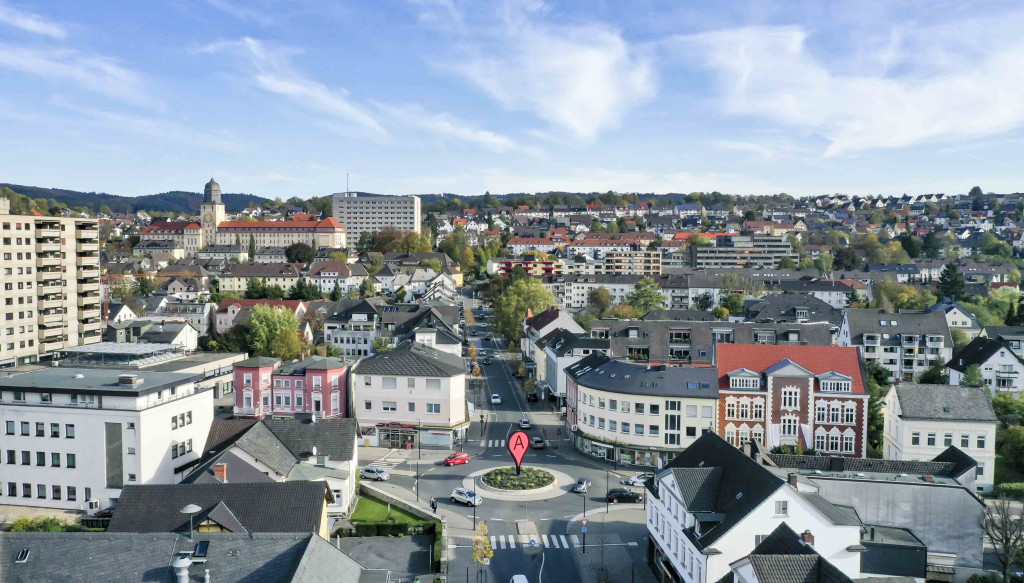
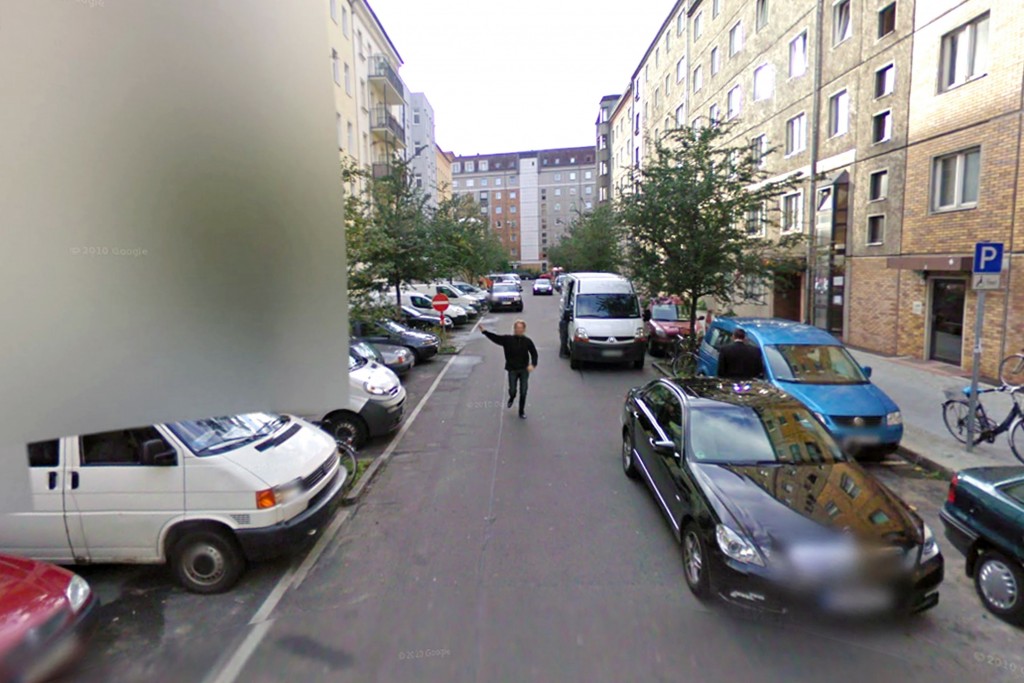
The project “Map” questions the red markers of the location based search engine Google Maps.

The web interface of Google Maps uses small graphical icons to show location related search results on a map in an alphabetical order. On each new search ten red markers (A - J) known from the analogue world find their new position automatically within milliseconds.


more...
Speed


The Installation Speed is a transformation of the big flashing arrows from the computer game "Need for Speed Underground 2, NFSU 2" to real space.
Although computer games always try to imitate the physical world there are always elements, objects and behaviours which only exist in the virtual world.
In the game NFSU 2 the player drives a car through a simulated city. Part of the game is to drive races against opponents. To make the race track more visible big flashing arrows separate the track from the rest of the city. The car of the player can not cross these boundaries but normal city traffic can.

.more...

First Person Shooter


First Person Shooter is the definition for a computer game genre which is played in the first person view while shooting is the main action of the game. A typical element of the game is the virtual arm of the player. Pointing with a weapon to the center of the screen this arm stays in the foreground all the time. The Object First Person Shooter is a card and a do it yourself set. The result of cutting and glueing all parts of FPS is a pair of glasses with the arm and weapon visible from out- and inside.

more...
WoW


The WoW project is a workshop and intervention in public space that uses computer play-worlds as a means of calling attention to the changing ways people deal with privacy and identity in the public sphere. Every day, millions of people spend a great deal of time in online virtual worlds like World of Warcraft.

more...
berlin east / berlin west


The Berlin Wall is an important stop for every sightseeing tour in Berlin. Every day many Berlin tourist are visiting the left overs from the Wall. Standing in front of the Wall almost everybody has a hard time to say which side was berlin west and which was berlin east. The postcard "berlin west / berlin east" is an analog Location Based Sevices and answers this crucial question for the most popular spots of the Berlin Wall. Part of the object is a compass which helps the user to orientate and to find out the direction of the former Westtberlin or Eastberlin.


more...

Screens
2005
TV-Filter


TV-Filter allows to downsample an ongoing tv-show to 6 by 8 pixels in realtime. A translucent projection folie is mounted on a 5 cm deep cardboard grid. The color and intensity of each pixel is determined by the correspondend part of the tv screen on the backside. The different color information of each tv line get mixed to an average color value on each 4 by 4 cm pixel. In this way it is thinkable to reduce every high definition screen to a pleasant information density.


more...

Random Screen


Random Screen is a mechanical thermo dynamic display which does not rely on any electricity.
Each of the 12 by 12 cm pixels is an individual entity. A tee candle lights and controls each pixel. The rising heat of the candle turns a modified beer can which turns the pixel on and off. Each pixel has its own frequence. The more bright a candle shines the faster is the rotaion of the can.

Each pixel is built as a seperate module. Random Screen keeps growing.

more...
Paper Pixels


Papierpixel (Paper Pixels) is an 8x8 pixel screen that’s controlled manually via a punched-card system. Each of the 64 pixels on the 50x50 cm projection surface on the front side of the screen is constantly illuminated by an equal number of light bulbs on the back side of the screen.Activating the individual pixels is done by a wide strip of paper pre-programmed with punched holes that runs between the pixel projection surface and the light source.The 64 tracks on this oversized punched-card determine whether a pixel is turned on or off.


more...
2004
de_dust


The de_dust installation consists of a large number of various sized stacked crates arranged in a cluster. All the crates are printed with the same imitation wood texture from the computer game Counter-Strike. What has been simulated in the 3D world with a texture covered form is transferred back into the world from which it originally came. The original function of the wooden crate as a packing medium is abandoned in the computer game Counter-Strike. Here the crates are used as design elements to complicate space and are a decisive factor in the course of the most-played internet-based ego-shooter. The crate, which is always the same, appears in varying sizes in the game-map called “de_dust“.

more ...
DIY


In “The Sims“, one of the most successful computer games of recent years, the player controls a family or other social group through their everyday lives. The welfare of each individual game figure lies in the hands of the player who can switch between characters. Diagrams and bar displays show statements on the condition of the virtual people. Are all their needs gratified? Love, fun, comfort, nutrition, ... “The Sims“ reflects our life. It attempts to simulate our complex everyday social life with its various relationships. The reproduction of the green rhombus which hovers as a three-dimensional marking over the head of the active figure transforms the world the Sims into our world.

more ...
Silver Cell


The mobile phone pouch Siver Cell acts as Faraday cage, completely shielding the phone and preventing it from sending or receiving signals. The material used, a flat silver-plated polyamide fabric is semi transparent. The phone display is still visible.

more...
2001
Bits on Location


Bits on Location is a research project into the relationship between mobile communication and physical space.In a series of examples an attempt is made to connect the digital content from locationless global data networks to physical space. Familiar qualities and functions could be transferred from the network data world into the area of everyday life. How does the data universe integrate itself into our physical and material world? What effect does the locating of data have on people‘s communication and social relationships?

2001 Thesis University of Arts Berlin, Winner of Browserday 2001
project site www.datenamort.de

cc Some rights reserved. All content on this webpage is licensed under Creative Commons license by-nc-sa 3.0 . Aram Bartholl 2009